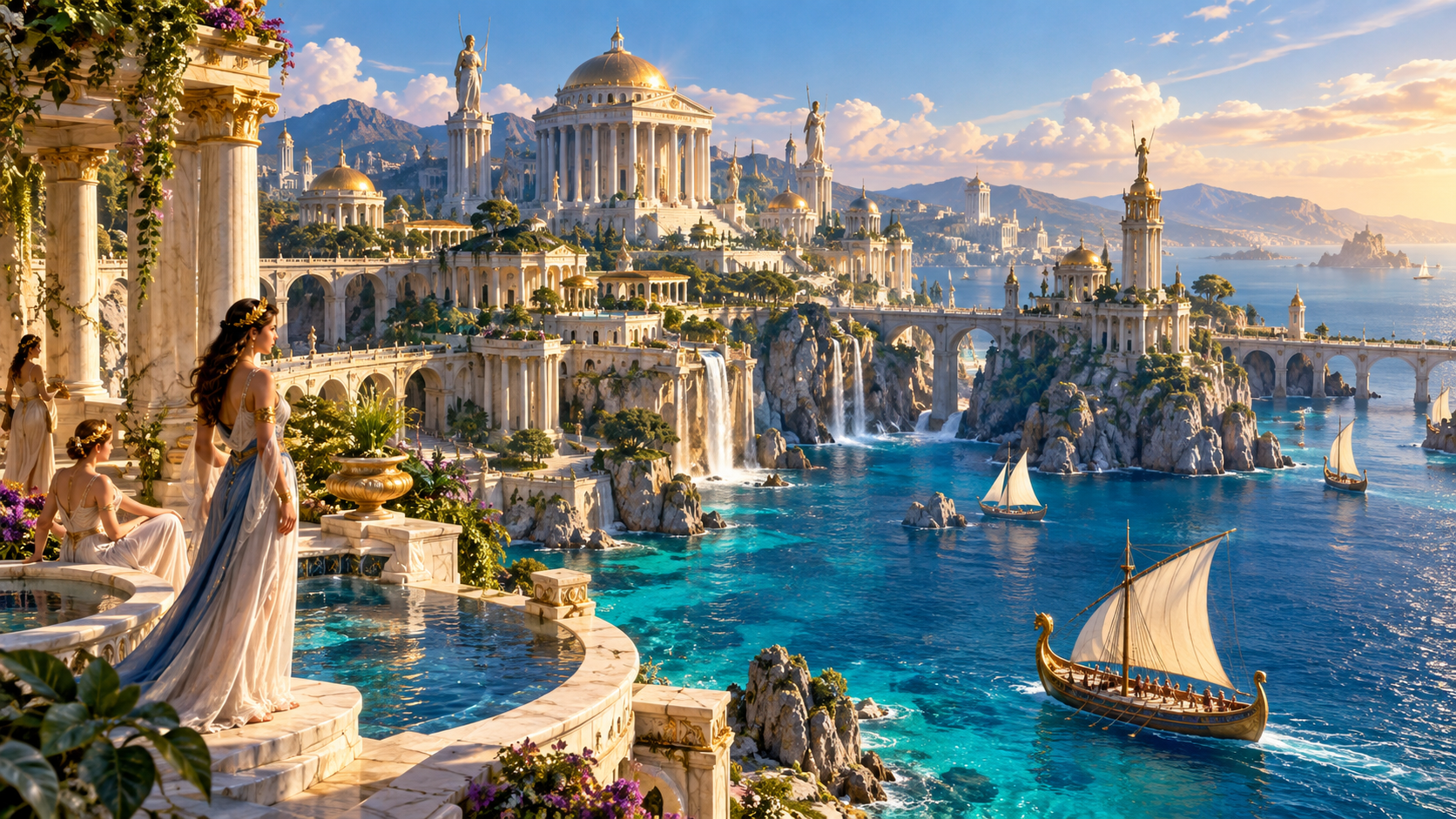
At the center of the Thalassa Archipelago stood Atlantis, the doomed city. Inhabited by humans and ruled by elves, its harbors connect dozens of surrounding islands. Atlantean navigators, mathematicians, and shipwrights possess knowledge far beyond that of the scattered tribes of the surrounding archipelago. Human sailors and elven scholars worked side by side. Great sailing ships carried iron, grain, glass, wine, and books between the isles.
Beyond Atlantis, however, most islanders remain poor farmers, fishermen, and warriors whose loyalty belongs to their village or clan.
Disaster strikes without warning. The gods, angered by a distinct lack of temple construction, smite the mighty Atlantis in a show of force designed to inspire fear in the hearts of mortals everywhere. Accordingly, the earth shakes, the sea withdraws and returns as an immense wall of water, and Atlantis fractures and disappears beneath the waves over the course of a terrible month. Refugees flee aboard anything that floats while surrounding islands are devastated by tsunamis.
Later generations will argue endlessly over what caused the catastrophe.
Ash and strange weather follow the destruction of Atlantis. Harvests fail across the islands. Trade collapses. Famine spreads. Atlantean refugees preserve fragments of their old knowledge, but desperate island communities increasingly distrust them.
Preachers proclaim that Atlantis was destroyed because its inhabitants offended the gods. The fact that humans and elves had lived together becomes central to their accusations.
A warrior-prophet named Hrothgar Ash-Eye boldly preaches that elven sorcery caused the destruction of Atlantis. After his mysterious death, his followers carry out a series of pogroms targeted at elves. Violence spreads from island to island, as elven homes are burned, mixed families are attacked, and ancient Atlantean books are destroyed as forbidden magic. Some human neighbors hide elves or help them escape, while others participate in the killings.
Thousands of elves flee the archipelago. Most surviving elves eventually settle in Avalon or among the communities that will become Metropolis. Thalassa becomes overwhelmingly human.
The last major Atlantean archive is discovered on the island of Skalla. Priests demand its destruction, but scholars resist. The resulting riot ends with the library burned and many of its custodians killed. Knowledge of mathematics, medicine, navigation, metallurgy, and engineering disappears with it. Nearly two centuries after Atlantis's fall, Thalassan ships are less sophisticated than those constructed before the catastrophe.
Competition over farmland and fishing grounds erupts into a sprawling conflict among nine powerful island rulers. Villages are burned for supporting rival clans. Captives become slaves. Blood feuds continue long after the original causes of the war have been forgotten. The Thalassans increasingly celebrate the warrior as their cultural ideal. The scholar, once honored in Atlantis, becomes an object of suspicion.
Warrior Harald Erikson conquers five major islands and declares himself King of Thalassa. He establishes a permanent fleet and attempts to prohibit private warfare among his subjects. Harald is assassinated twelve years later. His kingdom fragments almost immediately.
His reign leaves behind a dangerous idea: That the islands could be united.
Sailors, smugglers, outlaws, and disgraced warriors establish the Blackblood Brotherhood. They raid foreign merchant ships—and each other. Piracy becomes an accepted way of life throughout much of the archipelago. Successful captains become local rulers, while coastal communities depend upon stolen cargo to survive. Violence has become both an occupation and an institution.
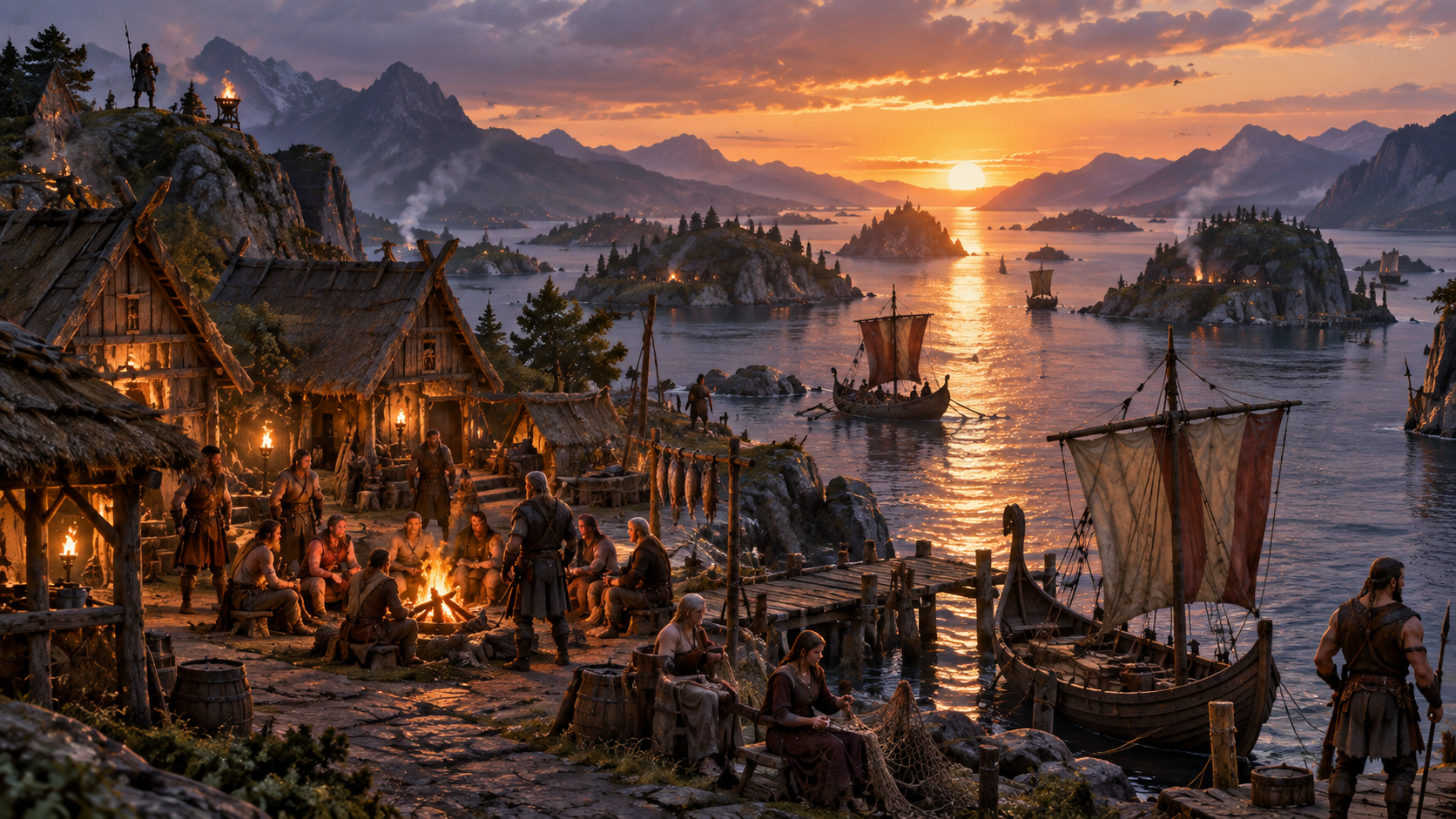
A succession of poor harvests produces another famine, causing old superstitions to return. Islanders accuse witches, foreigners, and malformed children of angering the gods. Some islands conduct purges, but on others there is resistance as others rally around the accused. For the first time in generations, a significant number of Thalassans openly challenge the culture of fear that followed Atlantis.
Navigator Freydis Orrsdottir discovers fragments of an Atlantean astronomical manuscript preserved by her family. She combines its knowledge with generations of sailors' observations and develops reliable methods for navigating beyond sight of land.
Her students establish the Navigators Guild. This event marks the return of Thalassan ships to the open ocean.
Thalassan raiders land on the Emerald Isle of Avalon following rumors of a massive treasure, where they encounter elves. Some pirates recognize elven names and traditions preserved in old Thalassan stories. They realize that many Avalonian elves descend from refugees their own ancestors drove from the archipelago. This does not prevent the raid.
Foreign merchants from Metropolis introduce reliable naval cannon. Thalassan smiths rapidly copy and modify them. Larger sailing ships appear, capable of mounting batteries of guns while crossing open seas. Traditional warriors initially dismiss firearms as cowardly, but after several spectacular demonstrations, their objections become considerably quieter. In the following decades, shipyards, foundries, ropeworks, and sawmills expand across the larger islands.
Pirate captains unite temporarily to raid the wealthy Transylvanian port of Vanzeer. The expedition captures grain, weapons, silver, and enormous quantities of contraband. Transylvania retaliates by employing privateers against Thalassan shipping. What begins as piracy becomes an undeclared naval war. For the first time in centuries, Thalassan captains discover that cooperation can be more profitable than fighting one another.
Steam-powered ships flying Metropolitan colors enter the archipelago. Thalassan sailors are stunned by vessels capable of moving against the wind. Metropolitan diplomats demand guaranteed navigation rights and offer to purchase several strategically located islands. Behind the diplomats come surveyors. Behind the surveyors come soldiers.
The islanders recognize the pattern too late.
A Metropolitan warship pursues pirates into waters claimed by a Thalassan jarl. When ordered to leave, its captain refuses. Warriors, fishermen, pirates, and local gunships attack together. Their antiquated vessels suffer devastating losses, but the Metropolitan ship is eventually crippled and sunk to the ocean floors. Any of its surviving sailors are summarily keel-hauled. News of the bloody "victory" spreads throughout the archipelago.
Following the death of King Ragnar IX, a succession crisis divides several major clans. Metropolis intervenes under the stated purpose of protecting commercial shipping and occupies three eastern islands. Mines are opened, and forests are cleared. Metropolitan administrators attempt to impose taxes to pay for the infrastructure they have constructed, but quietly choose not to enforce the imposed taxes after resounding public outcry.
Jarls, pirate captains, merchants, farmers, shipwrights, priests, and navigators gather for the largest political assembly since Atlantis. The arguments last eleven weeks. Three delegates fight duels. One pirate is thrown into the harbor. Nobody agrees on what the new government should look like, but out of sheer necessity the Great Moot is established, with representatives from every recognized island.
Thalassan engineers complete their first domestically constructed steam warship. The resulting vessel, the Stormdaughter, can cross oceans, maneuver under steam during battle, and endure naval broadsides due to its iron-plated hull. For the first time since Atlantis, Thalassan technology begins producing innovations other nations seek to imitate.
Workers excavating the ruins of the ancient Skalla monastery uncover documents describing the Elven Genocide. The Great Moot publicly recognizes that the elves were not responsible for Atlantis's destruction, and a memorial is constructed for the victims.
The declaration is controversial. Traditionalists denounce it as an insult to their ancestors, while others argue that acknowledging the old crime is necessary if Thalassa is to become something more than an alliance of frightened tribes.
Avalonian elves cautiously reopen formal trade with several Thalassan islands.
Metropolis sends a major naval force into the archipelago to crush attacks on its shipping and reinforce the occupied eastern islands. The Great Moot calls upon every island for ships, and are answered with great enthusiasm by men who love to blow things up. Warriors become sailors, while pirate vessels become part of a loose formal navy. Fishermen guide warships through reefs unknown to Metropolitan navigators. Foundries work through the night producing cannonballs. In the end, the Metropolitan fleet is forced to withdraw.
For the first time, victory belongs to no single island, clan, king, or pirate captain.
The Great Moot creates the Crown of the Isles and elects Admiral Mimir Stormborn as the first monarch of a genuinely united Thalassa. His authority is deliberately limited. The Crown commands the fleet and conducts foreign affairs, while the Great Moot controls taxation and law. Individual islands retain considerable autonomy.
Thalassa quietly becomes a nation without requiring its islands to surrender their identities.
Thalassa abandons a purely defensive strategy. Pirates receive royal commissions and join warriors in raids against Metropolitan railways, warehouses, mines, and coastal factories. Other expeditions strike Transylvanian ports. Thalassan forces also return to Avalon—but increasingly as uneasy allies and traders as well as raiders. The ancient pirate tradition becomes an instrument of national warfare.
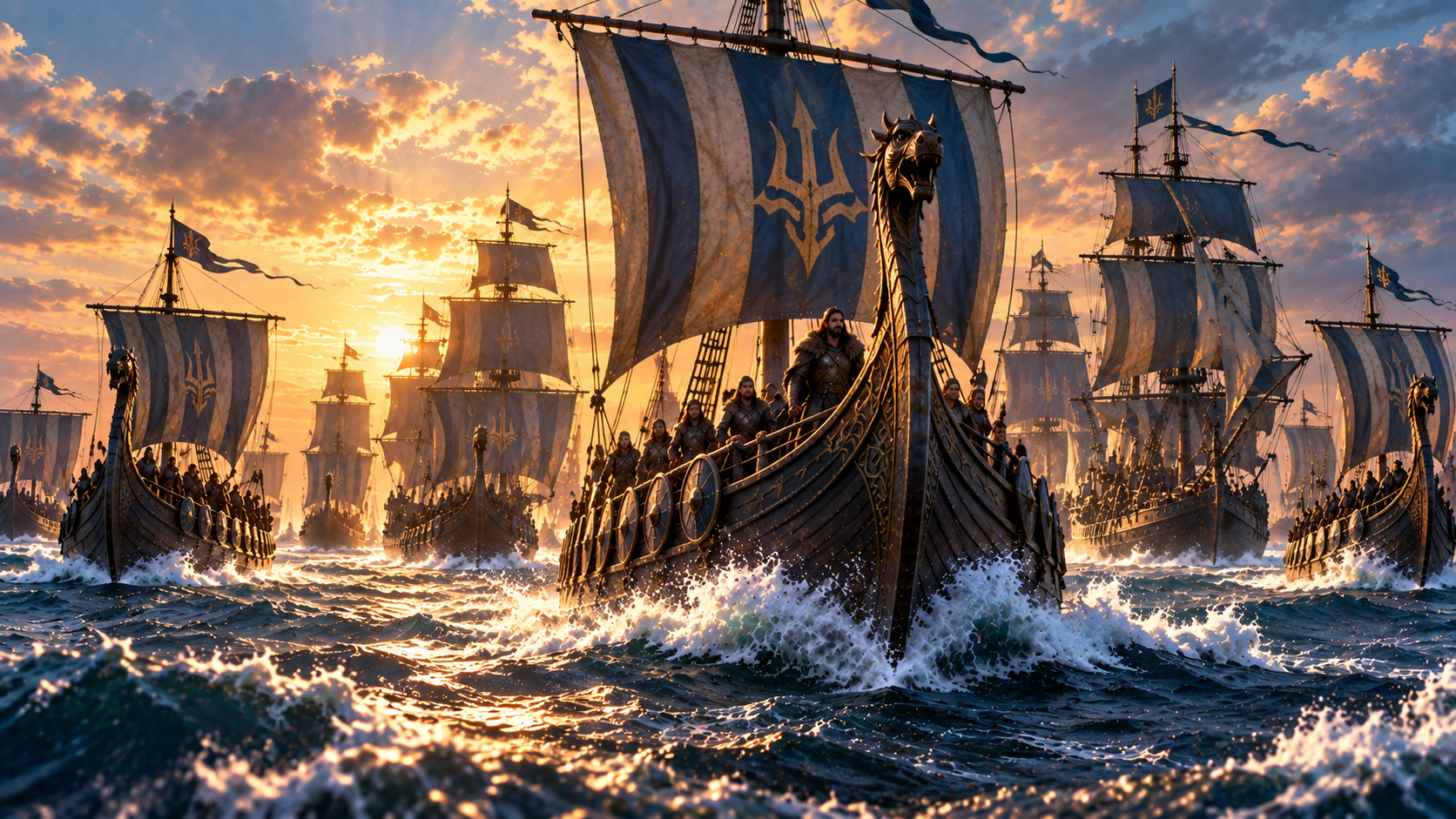
A thousand years after the height of Atlantis, the archipelago again possesses a civilization capable of rivaling its neighbors. Steam-powered battleships sail beside fast raiders descended from ancient longships. Breech-loading cannon replace primitive guns. Telegraph stations connect distant islands. Lighthouses mark dangerous passages. Shipyards and foundries surround the great harbors.
The warriors who once spent generations fighting neighboring clans increasingly serve together as sailors, marines, and soldiers. The pirates remain unruly, but many now carry commissions from the Crown and turn their talents against foreign fleets. And the fishermen, miners, smiths, merchants, and shipwrights provide the industry that makes Thalassan naval power possible.
Old feuds survive, and plenty of captains still prefer settling arguments with an axe. But the ruins beneath the waves remain a warning—not of the gods wrath, but of the price of disunity.